
Driveway Sealing
Cleaning, crack prep and two sanded coats of sealer on a residential drive, timed to the short run of warm nights in a Colorado Springs summer.
Typical: $250 - $800 for a typical two-car drive; long or hillside drives $500 - $1,700
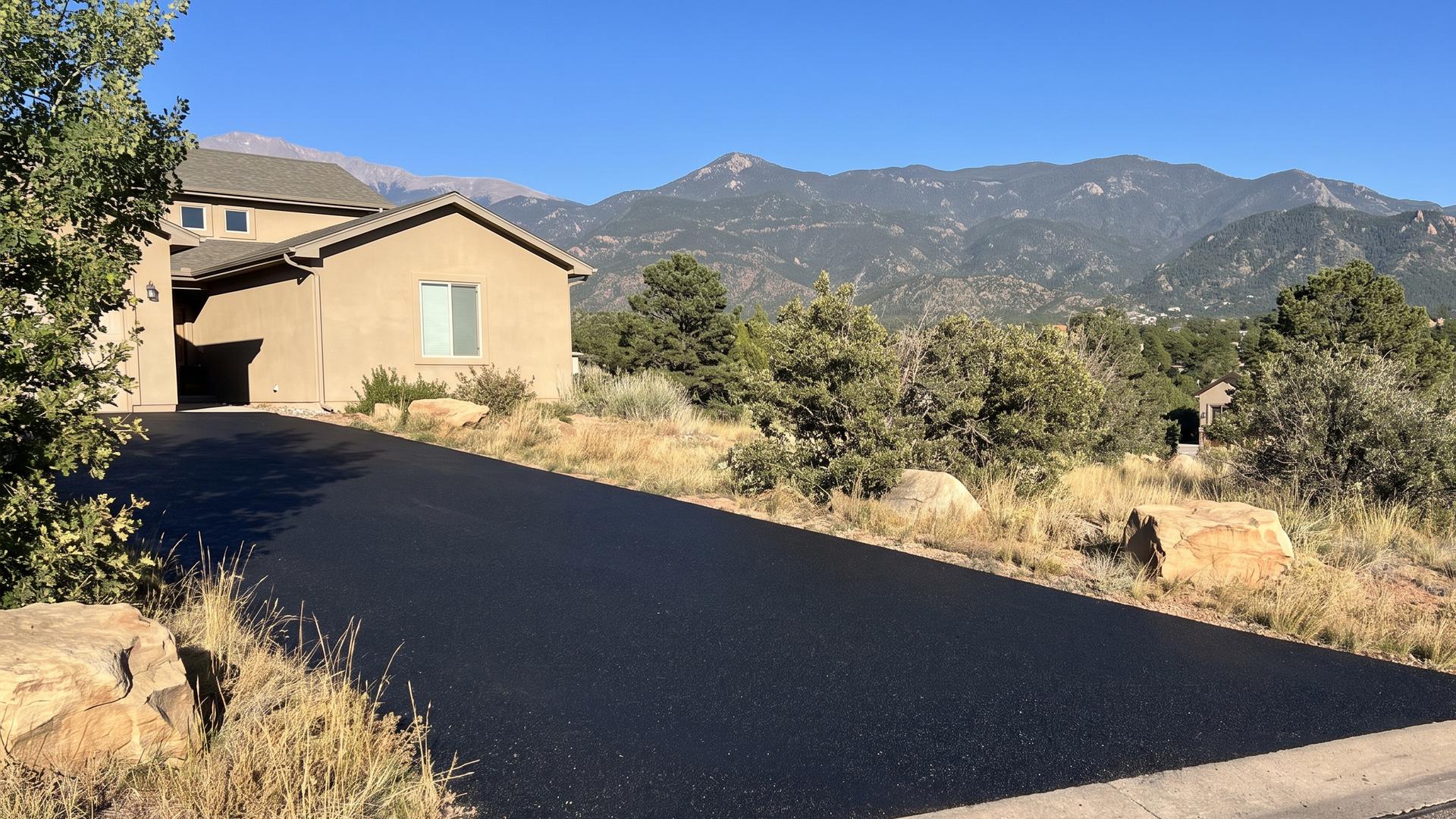
Pavement at the Colorado Springs airport dips below freezing and thaws again on about 135 days a year, and sealer wants nights above 50F, which the normals deliver reliably only in July and August.
NOAA's 1991-2020 normals for Colorado Springs Municipal Airport, a station 1,884 meters up on the east side of town, count 157.1 nights a year at or below 32 degrees but only 22.4 days when the high stays frozen. The difference, roughly 135 days, is how often the top of a driveway goes from frozen to thawed and back. From March through October the normal spread between a day's high and its low runs about 27 to 29 degrees. Water parked in an open crack is frozen, expanded and released on most of those days, and each round leaves the gap a little wider.
Under much of El Paso County the trouble starts below the asphalt. The county soil survey maps clay loams such as Razor, Midway and Kutch, which NRCS describes as formed from shale and other clayey rock, with 35 to 60 percent clay and slow permeability. In the Midway series, shale can sit only 10 to 20 inches down. The Colorado Geological Survey calls cracked and heaved driveways very common indicators of swelling soil, and it has mapped steeply dipping expansive bedrock across the western part of the city. A crack pushed up from below needs a different repair than one opened by sun, as the expansive soil guide explains.
The season for sealer is also the season for storms. Normal lows at the airport rise above 50 degrees only in June, July and August, and SealMaster's application guidance calls for 50 degrees and rising for at least 24 hours. July and August are the two wettest months of the year, at 3.12 and 2.96 inches, and Colorado's hail season runs from mid-April to mid-September by the insurance industry's count. Seal coating here comes down to finding a warm stretch with a dry day behind the final pass, in the same weeks that bring most of the rain.
This site is a plain-language reference for asphalt owners around Pikes Peak, built from public records: NOAA station files, NRCS soil descriptions, city and county road programs, local codes and published cost guides. The climate and road figures are tabled with their sources on the pavement climate data page, and the cost page shows observed price ranges for driveway sealing, crack filling and patching. The quote form passes requests to independent local contractors. Nothing here is a quote, and the site does not do the work.
Free quote
Cleaning, crack prep and two sanded coats of sealer on a residential drive, timed to the short run of warm nights in a Colorado Springs summer.
Typical: $250 - $800 for a typical two-car drive; long or hillside drives $500 - $1,700

Cleaning and filling asphalt cracks with flexible hot-pour sealant before winter, so snowmelt and summer storm water stay out of the clay and shale beneath the drive.
Typical: $1 - $3 per linear foot; small jobs usually carry a $100 - $250 minimum

Cutting out failed asphalt and rebuilding it, from a single pothole to a full-depth section, with the wet clay or tired base that caused the failure dealt with in the same visit.
Typical: $100 - $500 per pothole patch; $4 - $12 per sq ft for saw-cut, full-depth repair

Commercial sealing for business, church, school and HOA lots, phased so the property stays open and fitted into the brief run of warm nights a Colorado Springs summer allows.
Typical: $0.15 - $0.30 per sq ft for sealing; crack filling and striping priced separately

Restriping lots after sealcoating, plus stall layout, accessible spaces, fire lanes and arrows, painted on cured sealer and laid out to a plan rather than traced from faded lines.
Typical: $5 - $20 per stall; $25 - $50 per accessible space; arrows and fire lanes extra

A written calendar for driveways and lots: spring inspection after the last snow, sealing in the warm-night window, crack filling before the October freeze, and patches caught early.
Typical: Built from the parts: crack filling $1 - $3 per ft, sealing $250 - $800 every 3 - 4 years

New and replacement asphalt driveways: a base built for local clay, sand or granite soils, right-of-way permits at the curb, the hot-mix season, and the wait before the first seal.
Typical: $5 - $15 per sq ft for new or replacement asphalt; overlays about $1 - $4 per sq ft
Monument and Fountain sit roughly 1,400 feet apart in elevation, and a regional average blurs that. This site uses the Colorado Springs airport station for the city and separate NOAA stations where they exist: Monument's, at 2,158 meters, records 112.1 inches of snow in a normal year against the airport's 37.7, and Fountain's records 24.9. A driveway on the Palmer Divide and one beside Fountain Creek do not wear out on the same schedule.
Cost guides from HomeGuide, Angi and HomeAdvisor sit beside one Colorado Springs contractor's posted price sheet on the cost page, so the spread is visible before a crew walks the drive. Angi's Colorado average for sealing a driveway is more than double its national figure, which is worth knowing before comparing a local bid with a number read online. The ranges are observed market figures with their assumptions stated, not quotes.
In a county where mapped clay loams carry 35 to 60 percent clay over shale, a cracked driveway can be a soil problem showing up at the surface. These pages separate heave cracks from sun and cold cracks, point out when sprinklers or downspouts are feeding the clay, and say plainly when sealer would only hide something that needs patching or a new base.
Requests from the quote form go to independent contractors working in El Paso and Teller counties. This site does not do the work and does not claim any jobs. What it adds is context a bid rarely spells out: the city's 20 percent hillside driveway limit, Woodland Park's 17 percent rule, the license needed for apron work in the right-of-way, and the warm-night window that decides when a coat can go down.
A walk over the drive on a dry day sorts the job. Fine crazing on a faded gray surface is aging binder. A hump, a crack that follows the lawn edge, or a line that reopens after every repair points to swelling clay or a drainage fault below. That second group goes to patching and drainage work before any coat is priced, because on the clay loams mapped around the county the water in the subgrade is the cause.
Crews blow out dust and gravel, cut back turf at the edges and prime oil spots so sealer can bond. Cracks wider than a hairline get hot-pour rubberized filler, which stays flexible through 157 nights a year at or below freezing at the airport. Filling comes first because a sealer coat is only a skin: laid over an open crack, it splits along the same line the first time the pavement moves.
SealMaster's specification asks for surface and air at 50 degrees or more with no drop below 50 in the next 24 hours. At the airport that is dependable in July and August, when only one or two nights a month reach 50 or below; May averages 27 such nights and September about 18. Two thin coats with silica sand mixed in for grip go on early in the day, so they get hours of sun before evening.
SealMaster asks for 24 hours after the final coat before traffic. Sprinklers that reach the drive should stay off that day, and City Code 12.4.1304 already forbids irrigation that runs across a driveway into the gutter. Keep trailers and roll-off dumpsters away until the surface hardens. Then write the date down: one local contractor's price sheet puts the next coat three to four years out, not next summer.
The city covers 195.4 square miles of land by the Census Bureau's measure and counted 478,961 residents in 2020, with an estimated 494,743 by mid-2025. El Paso County as a whole reached 730,395, the largest county population in Colorado. The average home in the city was built around 1990, according to 2020-2024 American Community Survey estimates compiled by BestNeighborhood, so a great many original driveways have now been through three and a half decades of winters. Where a driveway crosses into the public right-of-way at the curb, City Code 3.3.5 applies: nobody may construct or repair a driveway, sidewalk, or curb and gutter there without a concrete contractor license and a permit.
The west side carries a geologic hazard of its own. In 1999 the Colorado Geological Survey published a map of expansive, steeply dipping bedrock in the western part of Colorado Springs, including the Pierre Shale and Niobrara Formation, warning that shallow expansive layers can cause destructive differential heave. The city had adopted a geologic hazard ordinance in May 1996 requiring such hazards to be identified and mitigated during development. The Pikes Peak Regional Building Department requires a soils report and engineered foundation for a new house, but its code exempts private driveways and sidewalks supported on grade from building permits, so the driveway itself never goes through a building permit review.
Winter supplies most of the cycling. Of the roughly 135 freeze-thaw days at the airport, about 69 fall in December through February and 30 in September through November, leaving around 35 for spring. Spring is also when a large share of the snow arrives: 13.7 of the 37.7 inches in a normal year fall from March through May, onto pavement that warms by day. The median last spring freeze is May 5 and the median first fall freeze is October 4, a 152-day season, with a one-in-ten chance of frost as late as May 16. Snow lies an inch deep or more on only about 29 days a year, and the city's own plowing FAQ notes that it tends to melt quickly, so most of it runs off as water.
Neighborhood streets are plowed last. The city maintains 5,833 lane miles across 194 square miles, sends its fleet to arterials and collectors first, and plows residential streets only after at least 6 inches has fallen; its FAQ counts two to three major snow events in a typical year. Treated salt, a sand and salt mix, liquid magnesium chloride and a product called Ice Slicer are all in use. Unincorporated El Paso County treats its 545 miles of Priority Three residential roads after 6 inches as well, with magnesium chloride and sand. The practical result is slush and deicer carried up driveways on tires and a berm at the apron, and the city suggests shoveling a pocket to the right of the driveway so the plow blade drops its load there.
Several local rules bear directly on a driveway. Inside the city's hillside overlay, individual driveways should not exceed a 20 percent slope and shared ones 15 percent, and a drive that serves as required fire access must be at least 12 feet wide with a grade of no more than 12 percent. City Code 12.4.1304 bans irrigation that pools on or flows across a driveway into a gutter or storm drain, and from May 1 to October 15 it prohibits most watering between 10 a.m. and 6 p.m. Colorado has no statewide ban on coal-tar sealants, and no Colorado city or county appears on Coal Tar Free America's national list of local bans. Runoff still matters: water from the city's drainage basins reaches Fountain Creek, which carries it down to Pueblo.
Public streets have been getting steady attention. Voters approved the 2C road tax in 2015, renewed it in 2019 at 0.57 percent, and in November 2024 extended it through December 31, 2035 with 73 percent of the vote. Coverage of that election credited the program with more than 1,677 miles repaired since it began, and the mayor said pothole damage claims against the city had dropped 80 percent. When a 2C crew mills and repaves a street, the fresh edge meets the end of every driveway on the block, and that joint between new street asphalt and an older apron is worth watching through the first winter.
These are observed market ranges for asphalt sealing and repair around Colorado Springs, drawn from national cost guides and one local contractor's posted prices. They are not quotes. The spread is wide: Angi's state table puts a typical Colorado driveway sealing job at $880 to $1,690, averaging $1,280, against a national average of $575, while a Colorado Springs contractor lists $250 to $600 for a typical drive. Size, slope, the amount of crack work and access explain most of that gap, and a bid that does not say which of them it includes is hard to compare.
| Service | Typical Colorado Springs Range |
|---|---|
| Two-car driveway, about 400 sq ft, cleaned and sealed | $250 - $800 |
| Long, three-car or hillside driveway, cleaned and sealed | $500 - $1,700 |
| Residential sealing priced by area | $1.00 - $2.00 per sq ft |
| Hot-pour crack filling | $1.00 - $3.00 per linear ft |
Published ranges put a typical two-car driveway of about 400 square feet at roughly $250 to $800 cleaned and sealed. One Colorado Springs contractor posts $250 to $600 for a typical drive and $500 to $900 for a long one, while HomeGuide's national guide prices 400 square feet at $400 to $800. Angi's statewide table for Colorado runs higher, averaging $1,280. Crack filling is usually billed separately at about $1 to $3 per linear foot. The full price table lists each range with its source.
Sealer wants air and pavement at 50 degrees or warmer through the first day, and the airport's normals show nights that warm mainly in July and August, with 1.2 and 2.3 nights at or below 50 in those months. June averages 11 cool nights and September about 18, so both work during warm spells. May still averages 27. The warm weeks are also the wettest of the year, so crews wait for a dry 24-hour forecast and start early in the day.
Several stresses stack up. The pavement crosses the freezing line about 135 days a year at the airport, and each crossing works any water in the cracks. Sunlight is stronger at altitude: the World Health Organization notes that ultraviolet levels rise with elevation because thinner air absorbs less of it, and SealMaster describes its sealer as preventing oxidation of the asphalt binder. Then there is the soil, with clay loams around the county that swell when wet. An unsealed surface takes all three at once.
No ban applies here. Colorado has no statewide restriction on coal-tar pavement sealants, and no Colorado city or county appears on Coal Tar Free America's list of local bans, which records statewide bans in places such as Minnesota, Washington, New York, Maryland, Maine and Virginia. Asphalt emulsion and acrylic sealers are the usual alternatives, and HomeGuide prices coal-tar and asphalt emulsion materials in a similar band. Because city runoff reaches Fountain Creek, it is still fair to ask which product a bid includes.
Work confined to private property generally does not need a building permit: the Pikes Peak Regional Building Department's code exempts private driveways and sidewalks supported directly on grade. The public right-of-way is different. In Colorado Springs, City Code 3.3.5 says no one may construct or repair a sidewalk, curb and gutter, or driveway in the city right-of-way without a concrete contractor license and a permit, so widening a curb cut or replacing an apron is permit work. Fountain, Monument, Manitou Springs and Woodland Park run their own right-of-way permits.
Yes. The Colorado Geological Survey says expansive soils can grow up to 20 percent in volume when wet and push with up to 30,000 pounds per square foot, and it calls cracked and heaved driveways very common indicators. It cites an interstate in eastern Colorado where as much as a foot of uplift forced two concrete lanes to be repaired six months after paving. Around the city the risk is highest where shale-derived clay or dipping bedrock is shallow. There is more on how heave differs from wear.
Only after at least 6 inches of snow has fallen, and only once arterials and collectors are clear, according to the city's snow plan. Storms of 12 inches or more with prolonged freezing bring out smaller 4x4 plows for neighborhoods. The city says plowing every residential street would take 110 more plows, which it does not consider a sound investment for two or three major storms a year. Until the sun clears it, packed street snow turns into slush at the apron, and the plow berm lands at the end of the drive.
Yes. SealMaster says clean silica sand belongs in the mix because it adds slip resistance, helps drying and adds durability, and its MasterSeal specification calls for 300 to 500 pounds of sand per 100 gallons of concentrate. That matters on hillside lots, where the city allows individual driveways up to a 20 percent slope and Woodland Park allows 17 percent between the right-of-way and the garage. A smooth coat without sand on a grade like that gets slick when it is wet or frosted.
SealMaster's guidance is 24 hours after the final coat, and its application instructions add that the temperature should not fall below 50 degrees during the first 24 hours. In Colorado Springs that means planning around cool nights: a coat laid in late May, when the normals show 27 nights at or below 50, can stay soft longer than one laid in July. Turn off any sprinkler zone that reaches the pavement, and park elsewhere overnight so tires do not scuff the surface.
Walk it once the ice melts and note loose stone at the bottom of the grade, bare spots in any sealer applied within the last day or two, and new cracks. A second risk arrives with the roofers: the Pikes Peak region issued more than 17,000 re-roofing permits in 2023 after that summer's hail, and a full 20-yard roll-off dumpster can weigh over 10,000 pounds. Ask for it to sit on plywood at least 3/4 inch thick. The hail post covers the rest.
Describe the driveway or lot, its slope and its cracks. The request goes to independent local contractors who measure and price the job themselves.
Free quote